Written by the Instructor Team at Nemo Dive Center · PADI 5-Star Resort, Halkidiki, Greece
Updated: June 2026 · 10-min read
About the authors: The instructors at Nemo Dive Center teach PADI courses in the Aegean Sea year-round. Knowing the history of what you're doing underwater changes how you experience it — this is the version of that story we share with students.
Key Takeaways
- Humans have been diving for food, pearls, and sponges for over 4,000 years — long before any breathing apparatus existed
- The Ama divers of Japan and the Haenyeo of Korea represent the oldest continuous free-diving traditions still practiced today
- The diving bell, first documented in the 16th century, was the first technology that allowed humans to stay underwater longer than a single breath
- In 1943, Jacques Cousteau and Emile Gagnan invented the Aqua-Lung — the direct ancestor of every scuba regulator used today
- The open-circuit scuba system remains the most widely used diving system in the world for recreational divers
- PADI was founded in 1966, which standardized diver training and drove the mass adoption of recreational scuba diving globally
- Modern advances — dive computers, BCDs, enriched air nitrox, and rebreathers — have made diving safer, longer, and accessible to more people than ever
Ancient Diving: Before Any Equipment Existed

Long before anyone invented a tank or regulator, humans were diving. The evidence is archaeological, textual, and biological — and it spans almost every coastal civilization in recorded history.
The Ama divers of Japan and the Haenyeo of Korea are the most documented examples. Both groups, predominantly women, have been diving for shellfish, abalone, and seaweed for more than 2,000 years. No equipment. No air supply. Just a single breath, a weighted descent, and decades of trained physiological adaptation. The Haenyeo tradition was inscribed on UNESCO's Intangible Cultural Heritage list in 2016 — recognition that this is not just history, but living heritage.
In ancient Greece, diving was documented as early as 500 BC. Greek divers — called urinatores in Roman texts — used a technique known as skandalopetra: a large flat stone of roughly 15 kilograms was used to drag the diver rapidly to depth, where they would harvest sponges or conduct military reconnaissance. Once done, they cut the rope and ascended on their own. Greek and Roman mosaics and frescoes depict these divers clearly, indicating how embedded the practice was in Mediterranean coastal life. Today, when we teach diving in the crystal-clear waters of the Aegean Sea here in Halkidiki, we are continuing a tradition that began thousands of years ago right in these waters.
These early divers used reed tubes and bamboo snorkels to breathe at the surface — the functional ancestors of every snorkel sold today. Some accounts describe primitive goggles made from polished tortoiseshell. The basic physics were understood: get down fast, work quickly, get back up.
What is remarkable is not how primitive these techniques were, but how effective. Ama divers regularly reached depths of 20–30 meters on a single breath — depths that many recreational scuba divers today would find challenging even with full equipment.
The First Diving Technology: Bells and Suits

The transition from breath-hold diving to mechanically assisted diving began in the 16th century with one deceptively simple idea: trap a pocket of air underwater and let the diver breathe from it.
The Diving Bell
The diving bell is exactly what it sounds like — a large, inverted bell-shaped vessel, open at the bottom, lowered into the water. As it descended, the trapped air inside compressed under water pressure, but a pocket of breathable air remained at the top. Divers inside could breathe from it in short bursts.
The first credible documented use dates to 1535, when Guglielmo de Lorena used a diving bell to explore a Roman shipwreck in Lake Nemi, Italy. In 1691, astronomer Edmond Halley — the same Halley of comet fame — significantly improved the design by sending weighted barrels of fresh air down to replenish the supply. His bell allowed divers to stay submerged for over 90 minutes, which was revolutionary for the time.
The diving bell's limitation was fundamental: you could not leave it. You were tethered to your air supply. Any task more than a few meters from the bell was impossible.
Early Diving Suits and Helmeted Diving
The next step was containing the air supply around the diver's body. In 1819, German-born engineer Augustus Siebe developed an early form of the hard-hat diving suit — a waterproof canvas suit with a copper helmet fed by surface-pumped air through a hose. By 1837, he had refined this into a fully sealed suit that became the standard for commercial and naval diving throughout the 19th and early 20th centuries.
Hard-hat diving made underwater construction, salvage, and military reconnaissance genuinely practical. It also made the limitations of a surface-tethered air supply glaringly obvious. The next logical step was cutting the hose.
The Aqua-Lung: The Invention That Changed Everything
By the early 1940s, several inventors had attempted self-contained underwater breathing devices. Most failed because they could not solve the same problem: providing air at the correct pressure regardless of depth.
The solution came in 1942–1943 in occupied France.
Jacques-Yves Cousteau, a French naval officer, had been frustrated by the limitations of rebreathers and surface-supply equipment during his diving expeditions. He approached Emile Gagnan, an engineer at Air Liquide who had been working on demand valves for gas-powered car engines during wartime fuel shortages. Together, they adapted Gagnan's demand regulator to deliver compressed air on the diver's inhale, automatically matching ambient water pressure at any depth.
They tested the first prototype in the Marne River in January 1943. It worked. They called it the Aqua-Lung.
Cousteau and Gagnan filed the patent in 1943. Commercial production began in 1946 under the Air Liquide brand. By the early 1950s, the Aqua-Lung was available in sporting goods stores in the United States, and a sport was born.
It is worth noting what the Aqua-Lung was not: a rebreather. It did not recycle exhaled gas. Every breath you exhaled went straight into the water. This open-circuit design was simpler, cheaper, and more reliable than closed-circuit alternatives — which is exactly why it became, and remains, the dominant system in recreational diving worldwide.
The Rise of Recreational Scuba Diving
The Aqua-Lung gave people the technology. What followed in the 1950s and 1960s was the culture.
Cousteau himself was the most important factor. His 1953 book The Silent World sold over 5 million copies. The 1956 documentary film of the same name won the Palme d'Or at Cannes and the Academy Award for Best Documentary — the first underwater documentary to do so. For millions of people, it was the first time they had seen the underwater world in colour and in depth.
The infrastructure of recreational diving followed quickly:
- 1953 — First commercial dive stores open in California
- 1959 — YMCA launches the first formal recreational diver training program in the United States
- 1966 — PADI (Professional Association of Diving Instructors) founded, introducing standardized modular training that is still the global framework today
- 1970 — SSI (Scuba Schools International) founded as a competing certification body
- 1960s–70s — Dive travel industry emerges; liveaboards, dive resorts, and dedicated equipment retailers establish the sport's commercial infrastructure
By the 1980s, scuba diving had crossed from niche hobby to mainstream adventure sport. Millions of certifications were being issued annually. Equipment was manufactured at scale, driving costs down. The sport was no longer the domain of military personnel, commercial divers, and a small community of adventurers. This boom brought eager explorers to prime dive destinations worldwide, including the beautiful coastal regions of Greece, such as the stunning Kassandra and Sithonia peninsulas.
Gear That Shaped the Sport
The Aqua-Lung was the foundation, but the gear that surrounds it today was built over decades. Each innovation either expanded what was possible or reduced what could go wrong.
The Dive Computer: The Single Biggest Safety Advance
Before dive computers, every diver carried a set of paper decompression tables — printed charts that calculated how long you could stay at a given depth before nitrogen saturation became dangerous. The tables were conservative by necessity: they had to assume worst-case scenarios. In practice, they were also easy to misread, forget, or lose.
The first commercial dive computer — the Orca Edge, released in 1983 — changed this permanently. It calculated real-time nitrogen loading based on your actual dive profile, not a predetermined estimate. Modern dive computers now monitor depth, time, ascent rate, tissue loading, gas mixture, and surface interval simultaneously, with visual and audible warnings for violations. They are one of the primary reasons that diving fatality rates have declined steadily over the past four decades.
Scuba Diving Today
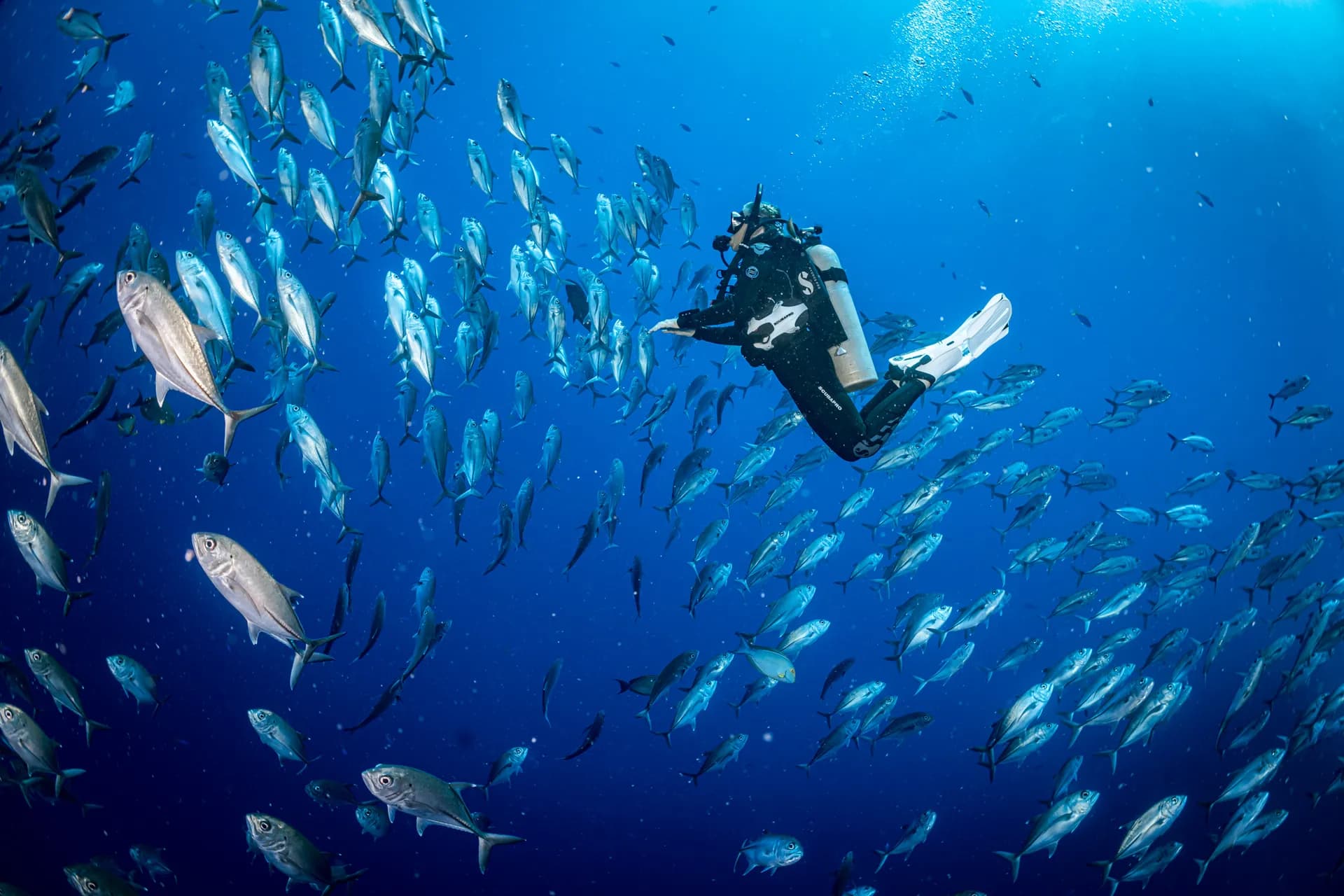
Modern scuba diving sits at the intersection of sport, science, and conservation. The technology is more capable than at any point in history; the community is larger; and the awareness of the marine environment that diving creates has made divers one of the most active constituencies in ocean conservation.
The Current Scale of the Sport
- Over 6 million new recreational divers certified annually worldwide (PADI)
- An estimated 6–10 million active divers globally
- Dive tourism is a multi-billion-dollar industry, with dedicated dive destinations in every ocean basin
- Marine conservation organizations rely heavily on trained divers for reef monitoring, species surveys, and debris removal
If you are new to diving and want to understand where you fit into this history, start with our complete beginner's guide to scuba diving — it covers everything from your first breath underwater to choosing a certification pathway.
External sources: The Cousteau Society · Aqua-Lung history — Wikipedia · PADI.com
